and Join the
Socialist Workers Party!
--- On the Nature and Significance
of the SWP Program ---
The Central Executive Committee of the Socialist Workers Party
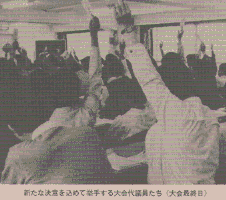
(The photograph is the inaugural meeting of SWP which adopted the new program unanimously)In May [1984] we formed a new workers’ party—Socialist Workers Party [Sharōtō].
Around the time of the 1960 anti-AMPO [US-Japan Security Treaty] struggles there were already calls for the creation of a new workers’ party, and in a sense our own Marxist Workers League* (Marurōdō—MWL) was a new workers’ party. Today, however, with the increasing rottenness of the LDP government, the beginning of dangerous military expansionism, and the bourgeois degradation of the JCP, we believe that the time has come to aim for a quantum leap forward through the creation of a new workers’ party. Here we have set out our program and party rules, and call on all class-conscious workers throughout the country to combine their organizational strength within our party.
*
The MWL is the predecessor of the current SWP. It was formed in 1971, and in 1984 the MWL became the SWP. For more on the history of the MWL and SWP see “A Short History of the Creation of the SWP” in this pamphlet.This program and party rules was adopted at the founding congress of the SWP in May 1984. The program represents the open banner of the party, which provides a general understanding of the SWP. For the working class to realize socialism, it is necessary for all of the militant workers to rally together and combine their class resolve and struggles, and give this organizational expression. The party program provides a common foundation for this mobilization—politically and practically. We anticipate that many workers will recognize the significance of our program, study it, recognize our shared desires and objectives, and then join in our struggles and advance together.
What, then, are the characteristics of our new program; how is it different from that of the Social Democratic Party (SDP) and the Japanese Communist Party (JCP); how does its content relate to the liberation struggle of the working class?
The program of the MWL already defined the Soviet Union and China as “state capitalism,” and rejected, as opportunistic nonsense, theories held by the JCP—such as the idea that Japan is a “a semi-colony of the U.S,” their “two-stage strategy of revolution,” “democratic-reform” line, and the political tactic of the so-called “democratic united front.” But now the program of the SWP has deepened the analysis of some areas and developed our standpoint.
This development is seen first of all in our understanding of modern capitalism and the world system. That is, we define the Soviet Union and China as capitalistic states, and therefore recognize the inevitability of nationalism and imperialism in these states. This means that the modern world can also be defined as the world of imperialism, and we have clearly defined this as “‘the highest level” of imperialism.” We clearly reject the vulgar characterization of the present period in terms of a “conflict between the capitalist and socialist blocs.”
Moreover, in terms of our understanding of modern capitalism, we abandoned the concept of “financial capital” developed by Hilferding.
We have also decided to treat the concept of “proletarian dictatorship” more precisely, and to not employ this concept in the new program. The program of former MWL was vague in this respect, and there was a section where the term of “proletarian dictatorship” was used. However, the program of the SWP uses the term “political rule” or “power” of the working class, and we are confident that this is a correct decision
In the course of our debate on “proletarian dictatorship,” it became clear that all of our members recognize that the victorious working class would have to use its power to crush the resistance of reactionaries and big capital if necessary. In other words, our party members recognized the necessity for a sort of despotism (proletarian dictatorship). Why, then, did we remove this term from our program?
The reason is simply that we do not think that this aspect of the working class government is something essential or characteristic (nor would it be correct to define it as such). Rather, we think that it is more necessary and essential to clearly define the political rule of the workers as a “half-state,” in other words a state that has begun to wither away and which is already not a state in the sense of being a repressive state. Moreover, unlike the “worker and peasant” Russian or Chinese revolutions, the coming revolution in Japan is only possible as a socialist revolution of the working class. We believe that the political rule of the working class will directly appear as a “half-state”—this is the deepest reason for removing the term “proletarian dictatorship” from our program. An additional reason is our consideration of the historical fact that the Stalinist states (the USSR, China, Eastern Europe, North Korea, etc) appeared—and in some cases still appear—as despotic states hiding behind the name of a “dictatorship of the proletariat.”
In our program, we have also added a section (part 4) that theoretically clarifies the “content of socialism,” as well as an elucidation of the means and path of workers’ struggles (part 5). Another section (part 7) has been added that lists “concrete demands” to be achieved either with the realization of socialism or in the process of the struggle to achieve socialism. These additions were necessary because the Socialist* and Communist parties in Japan have terribly distorted the concept of socialism. It was necessary to provide an image of the essence of socialism as the “solution to capitalist contradictions,” on the one hand, and also to show that socialism is not simply an abstract ideal, but rather a real task for the working class, deeply connected to the concrete political, economic and social demands.
*
The Socialist Party no longer exists.These are the characteristics of our new program, but even from this brief description its great significance should be clear. This program represents something completely new and revolutionary compared with existing “leftwing” dogmas and common sense of the SP and JCP.
In a word, our program starts from a deep distrust towards so-called existing socialism (Soviet Union and China, etc.), and therefore towards the officially recognized parties of socialism and communism (SP and JCP). We questioned whether the USSR and China are indeed examples of socialist societies, and whether the SP and JCP can truly be called socialist or communist parties. At the same time, however, we have no organizational or practical points in common with the idiotic radicals of the “New Left” in Japan (i.e. Chukaku, Kakumaru, the Reconstructed Bund, Fourth International). Our slogan has been, and remains one of “Opposition To Right And “Left” Opportunism!—that is, opposition to both “leftwing” radicals and the Socialist and Communist parties on the right. We oppose all of these “existing” parties, because they are part of the “establishment” (are bourgeois parties) and have already been corrupted to the point that by no stretch of the imagination can they be considered workers’ parties.
We call on workers throughout the country to seriously examine the existing leftwing and pseudo-workers parties, such as the SP and JCP, while at the same time examine our program. We are convinced that this will clearly reveal which side is speaking the truth.
Individual workers are powerless, and the personal dissatisfaction, anger, and resistance of isolated workers alone is insufficient to revolutionize this society. But the organized power of tens of thousands of class-conscious workers is all-powerful. All of the strength and fighting spirit of the workers needs to be combined into one force. Our program is the common foundation and starting point of this struggle.
(June 1984)