SWP Program in 1993
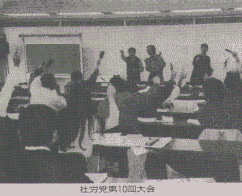
The Maximum Revision is the Evaluation of the State Capitalism(The photograph is the 10th general meeting of SWP which revised the program)
Contents
The 10th Party Congress of the SWP made some important revisions to the SWP program. Since it was adopted ten years ago, none of the fundamental parts of the SWP program have been revised—since this program has correctly defined the real political and economic processes in a principled way, and this was also confirmed by our struggles over these ten years. Still, it is a matter of course that a party program will have to be altered somewhat from time to time. The general content of the program of a workers’ party must be able to correctly lead the working class through various periods and stages of the revolutionary movement. Our program has solidly responded to this task. But the turbulent new situation of these past ten years—most notably the collapse of the Soviet Union—demands that we add some clarifications to our program. This is the precise reason and significance of the revisions in the program at this time.
Evaluation of the Capitalist Changes in Russia & Other Countries
We have not essentially altered of our program, and its revolutionary and proletarian nature remains completely intact. The changes we have made involve a principled evaluation of the changes in the world situation accompanying the collapse of the Soviet Union and the disintegration of the Soviet Communist Party—that is, the new situation that has emerged with the open free market changes and capitalization of the system that was mistakenly called “socialism.”
Of course, our original program already discussed the bourgeois changes in the “socialist” systems. We had a profound understanding of the bourgeois essence of modern “socialism,” and therefore concluded in our program, quite correctly, that this “socialist system is really just another word for state capitalism.”
Moreover, we carried out a consistent, historical, Marxist criticism of the state-capitalist system (i.e. Stalinist system), instead of merely offering a moralistic criticism. In our program, we also clarified that this system necessarily had to advance towards “liberalization,” and clearly defined the significance of this development. We carried out this analysis over twenty years ago, during the period of the Marxist Workers League. For example, the program of the MWL adopted in 1972 defined the socialist system (i.e. state capitalism) in the following way—and this view has been inherited by the SWP:
The economic “liberalization” carried out in the late 1960s in the USSR, and roughly ten years later in China, was not simply some sort of mistaken policy or the result of “revisionism,” but rather exposed the essence of state capitalism and its hidden nature. The further strengthening of the state-bureaucratic system of state capitalism would lead to stagnation, while a development in the opposite direction would release the nature of capitalism. But this “liberalization” has great significance in terms of showing the workers that the USSR and China are not socialist societies, but rather a type of capitalist society that opposes the working class. In this sense, this is the starting point for the creation of a new struggle to fight for real socialism.
It is clear that already more than twenty years ago we correctly foresaw the historical development and reality of the USSR and China. The situation in Russia and China has progressed in the manner that we indicated in the MWL program. Our recognition of the need to revise parts of our program is due to the fact that “liberalization” has entered a new stage with the monumental, or even qualitative change resulting from the collapse of the USSR, Russia’s integration into the bourgeois world, and the collapse of the Soviet Communist Party’s rule. It should be pointed out that we anticipated this process. Still, our understanding was limited to a somewhat abstract definition. The MWL program stated, for instance:
The contradiction between the existence of capital as a state monopoly and its essence as capital is what determines the present-day “liberalization.” At the same time, this contradiction makes the shift from state capitalism to socialism inescapable. Within the process of “liberalization,” the workers reappear as a class, and this marks the starting point for a new class struggle of the workers in the Soviet sphere. The development of state capitalism in China is also creating a broad, powerful working class. The struggle of the working class within the “socialist” systems has the same character, and the same historical significance as the struggles of the working class against capital in the “liberal” countries.
The Soviet Union, Eastern Europe, and China, etc., which have followed the line of “socialism in one country” or “self-regeneration,” and cut their markets off from the imperialist world market, are now returning to this world market. This has resulted in more exchanges between countries throughout the world, and provides advantageous conditions for international solidarity between the working-class movements.
Moreover, the program of the SWP, adopted in 1984, says the following:
The uplift in the struggles of the Polish people at the beginning of the 1980s was a typical class struggle of the workers in both form and content. Despite its insufficiencies and theoretical confusion, this struggle was aimed at the bureaucratic dictatorship of state capitalism and its party (Unified Workers Party = Communist Party). This is significant as the beginning of the open class struggles of the working class in a state capitalist country.
We have fundamentally inherited the definitions in our program up to now, while organizing these ideas in order to apply them to the understanding of the new situation. The outcome of this is the following:
In the most developed state capitalist countries, “liberalization” has reached the stage of open “capitalization.” Still, this does not mean a shift to conditions of “free competition” such as were dominant in the 19th century, but rather a transformation, more or less, to state-monopoly capitalism. And when this stage is reached, the workers’ struggles shift from that of liberal democracy struggles, to clear class struggles. The forerunner of this was the Polish working class struggles in the early 1980s. These struggles developed and expanded in the former Soviet Union and “socialist” countries in Eastern Europe.
In our Party Congress, we discussed the nature of the system emerging as a result of such “capitalization.” In our new program, we offer the tentative definition of the former USSR as “state and monopolistic capitalism.” This reflects the fact that at this stage we cannot clearly determine whether or not capitalistic changes in Russia and elsewhere will lead to a capitalist system similar to that of Western Europe. The tendency towards a form of open capitalism is clear, but it is not yet certain where this will lead and what form the class struggles of the workers will take, since this depends on a number of factors. It is apparent, however, that regardless of what sort of capitalism is “introduced” or what kind of market economy develops, it is a fantasy to think that a system of capitalism ruled by free competition will emerge. A “more or less state and monopolistic capitalism” will probably appear that will be similar to “Western European” capitalism, but it is not necessarily certain whether this will fundamentally overcome the content of what we have defined as “state capitalism.”
The Beginning of the Struggle Aiming for World Hegemony
Another important point is that our new program defines the current world situation in light of the following: the end of the postwar period in which “two systems” (i.e. “liberal” capitalism and state capitalism) opposed each other; the reintegration of state capitalism (“socialist” systems) within the global capitalist system; the shift to a new world system; and the beginning of a global reorganization to include the former “socialist” states. For example, the new program states:
The progression of state capitalism towards becoming an openly bourgeois society, however, led to the dissolution of the USSR and eastern European states, and prepared the way for the end of the rule of the Communist Party (Stalinism—i.e. autocratic state capitalist bureaucrats). These states became divided in many cases, and the ideology of nationalism emerged to replace that of state capitalism. The fall of the Soviet Union thus seemed to mark the worldwide victory of “free” capitalism centering on the United States, and the reunification of the world as a global capitalist system. However, the development of the European Union, Japan’s economic and political emergence, the appearance of China as a great political power, and the relative economic decline of the United States as a great imperialistic power after the collapse of the USSR, all signify that the world is certainly not stable, nor will it be “unilaterally” ruled by American imperialism. In reality, this shows us that the world is witnessing profound economic and political crises, and heated struggles between states seeking hegemony, and this marks the beginning of new worldwide struggles and realignments.
The dissolution of the Soviet Union and the end of the age of Stalinism is at the same time the period of oscillation and dissolution in the imperialist rule of the United States. Thus, the world is moving towards a period of new upheavals and struggles. In our new program, we clearly state that in this tumultuous period, the resolute class struggles of the workers can open up a new future for humanity.
Additions Concerning the Question of Korean Residents in Japan
Other additions to our new program include new evaluations of the collapse of the LDP government and appearance of the Hosokawa coalition government, and some important additions to the “concrete demands” listed in Part 7.
First of all, the addition regarding the political situation is the following:
In the early 1990s, some fractions split from the LDP, and pseudo “progressive” parties (Social Democratic Party, Komeito, Democratic Social Party, etc.) maneuvered to form a coalition, but such a coalition government would only signify the appearance of a deceptive bourgeois liberal government, or even the transition towards an unconcealed imperialistic government.
The significance of this new addition should be clear. The Hosagawa government currently has a seventy percent approval rating. However, the illusions towards this “deceptive bourgeois liberal government” will inevitably disappear and this approval rating will no doubt drop dramatically. This coalition government has revealed its particular reactionary nature as a pseudo liberal government that has even begun to make “a transition towards an unconcealed imperialistic government.” Workers can only have one attitude towards this government: the call for its revolutionary overthrow. Our new program makes this point perfectly clear.
In terms of the additions to our “concrete demands,” our first addition was in the third demand pertaining to the struggle against discrimination where we call for: “Granting to those taken forcibly to Japan from former Japanese colonies, as well as their descendents, the right to freely chose their nationality.” Other additions were in the fourth demand: “The total abolition of the remnants “ranking system,” which is in opposition to the general spirit of democracy, and the end of the “symbolic” Emperor system.” Changes in the sixth demand concerning education were also made to include: “The elimination of all nationalistic education, such as the forced implementation of hinomaru (rising sun flag) and kimigayo (national anthem).” Finally, the concept of “the creation of proletarian culture,” used in the old program, was changed to the wider concept: “The encouragement and creation of a proletarian socialist culture.”
The meaning of the last two additions is clear. These two revisions were not proposed by the Central Committee, but rather were offered as proposed revisions at the Party Congress, and adopted by the congress representatives. The proposals submitted at the Congress were the following:
On the first proposal: We have had a vigorous debate within our party on the “discrimination problem” towards Korean Residents of Japan, and reached the conclusion that the foundation for the “discrimination” lies in “nationality discrimination.” Based on this, our standpoint should be clearly expressed within our program.
Today, the bourgeois state in Japan is “giving” Korean Residents of Japan the path of having Japanese citizenship. However this is a matter of “giving” and is not recognized as a “right” that Korean Residents of Japan can choose. For Korean Residents of Japan, citizenship in Japan was “taken away” on the one hand, and they did not become Korean Residents of Japan of their own free will. Korean Residents of Japan should have the right to freely choose between the citizenship of North Korea, South Korea, or Japan. In our program, we can make clear our position of opposing all “discrimination” against Korean Residents of Japan, while at the same time opposing the nationalism of Korean Residents of Japan, and leading them instead towards proletarian class struggle.
On the second proposal: The so-called “symbolic” emperor-system introduced after the war is certainly an “ornament” of monopoly capital. Of course, the “emperor-system” is a remnant of the ancient or feudalistic systems, and its obnoxious “discrimination” (discrimination on the basis of “rank” determined by one’s birth) runs completely counter to democracy in general. This emperor-system functions as a rallying point for many reactionaries, and plays a harmful social and political role that is not insignificant. Therefore, this system must be completely abolished. Seen from the perspective of the tasks of socialist revolution, the abolition of the emperor system is a reformist task. Still, it cannot be said that this slogan is without significance.
This is a summary of the content of the revisions in our program and their significance. We believe that by means of revising our program, we will be able to better indicate the struggles of the working class in order to provide correct leadership.
From the December 5, 1993 issue of Weekly Workers Newspaper [Central Organ of the SWP-- now called Umitsubame]