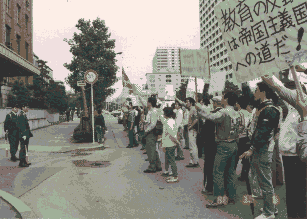
 Workers in Japan! And workers all over the world! Fight Together with the SWP to realize World Socialism!
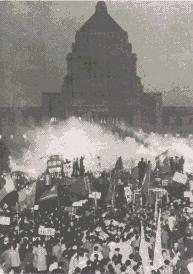
The photograph is 1960 Anti-Anpo Struggle
in front of the Diet (June the 17th)
SWP was formed in May, 1984. We formed this new workers party, because, Social Democratic Party of Japan and Japan Communist Party which had been would-be workers parties, had become completely corrupt. They had not been true socialist parties since early times, but they had become corrupt more and more recently, and had been given up by workers. They threw away the ideal of socialism completely which had been the ideal of workers all over the world for many years, and fell into the complete bourgeois reformist parties. Therefore SWP had been fighting to build a mass party, which can develop class struggles of the working class to overthrow the domination of monopolistic capital through revolutionary ways.
By the way, it is 1984 that SWP was formed, but there ware long and painful history of fighting for more than 20 years until that time. So, we'll introduce ourselves, mainly on the process of why and how we ware born, to have you know roughly about what kind of party the SWP is(if you want to know our ideological and theoretical standpoint, please read our platform printed in this home page. ).
The history of our fighting dates back to the Nationwide Study Group of Social Science(Zenkokusyaken) that was formed in December, 1963. The first radicalist movement in which the Bund(the Communist League) took a leading part, reached a summit in 1960 Anti-Anpo Struggle(struggle against Japan-US Security Treaty), but the struggle was defeated and the movement was scraped and splited into many factions. Zenkokusyaken was born from that process.
Japan Communist Party of those days was based on the wrong dogmatism that Japan was an American dependency, and had persisted in anachronism that the coming revolution of Japan should be the revolution of racial independence and realizing democracy. And also, they had fallen into various opportunism on practice.
Therefore, after the Polish, Hungarian anti-Stalinist Riot happened in 1956, the student members of Japan Communist Party began to have their doubt about the viewpoints that Stalinism was perfect and faultless and the Soviet Unions were socialism. As a result, they parted from Communist Party and formed the Bund(the Communist League) and held hegemony over 1960 Anti-Anpo struggle.
This first Bund of Japan had clearly recognized that the coming revolution of Japan would be the revolution to realize socialism in Japan, because the domination of monopolistic capital already had established in Japan those days, and also she already become independent of the United States after San Francisco peace treaty in 1952. Accordingly, the revision of Japan-US Security Treaty in 1960 did not mean that Japan would be even more dependent on U.S. which was claimed by Communist Party. On the contrary, the revision only meant that Japan had become more independent state from U.S. and she tied an imperialistic alliance with U.S. But, on the other hand, the Bund had embraced a radicalist's fancy to their fight. They were thinking that the revolution would happen immediately after they would crush down Japan-US Security Treaty by force, i.e., an imperialistic alliance between Japan and U.S. Therefore, they were dissolved by theirselves and divided into many factions, after the treaty was finally approved and the struggle was defeated.
Zenkokusyaken was also born from those processes. But, they were formed by the most proletarian wing in the first radicalist movement.
"Zenkokusyaken had its origin in the Communist's flag sect which was a faction of the Communist League. And this sect was born from the collapse and the factional struggle of the first Bund which was broken out from 1960 to 1961. After the breakdown of first radicalist movement which was carried on from 1958 to 1960, the so-called 'criticism on radicalism and criticism on Blanquisme' dominated their world. Of course, we started our movement taking these criticism positively. Accordingly, our task was to sublate petit-bourgeois radicalism and to form a real organization of the proletariat, and also was to organize a revolutionary proletarian political struggle. This task was not revised even now." (the collection of Zenkokusyaken's resolutions, 23 page).
Many trueborn radicalists who were in the leading position of the Bund, insincerely criticized themselves, and transferred easily to the Nationwide Committee of Revolutionary Communist League which had been criticizing 'Blanquisme of the Bund' most severely. We rejected those easy transference, and chose the completely deferent way, because we took in that this Revolutionary Communist League's criticism on Blanquisme was deceptive and they were also a kind of radicalists.
It is impossible to organize a revolutionary political party, without really sublating radicalism and obtain the scientific knowledge about our present-day world and the ideology of the proletaliat. And also it's entirely meaningless to call ourselves as a political party in name only, without linking ourselves to the advanced parts of the proletaliat.
Therefore, we did not organize a political party immediately at that time, but, only organize Zenkokusyaken(The Nation Wide Study Group of Social Science) which was a preparatory study group for a real party.
Zenkokusyaken's rules were very simple and had 5 articles. It's aim stipulated in Article 2 was as follows.
"The members must keep the principles of Marxism-Leninism, and must make efforts to apply them to class struggles. For that, the task of the moment was to prepare theoretically and practically to organize a mass communist party of the working class."
And also, we published No.1 issue of our organs called 'The Study Of Scientific Communism' immediately after Zenkokusyaken was formed, and we made our ideological standpoints clear in the issue. Namely, we claimed that our aim was not 'to organizing communist movements immediately', but, was to prepare theoretically and practically for that purpose. Particularly, we emphasized the necessity of theoretical study.
In this way, Zenkokusyaken was formed as a circle. However, it was not a ordinary circle, but was a revolutionary Marxist circle. Its main activity could not help but studying, because of its feeble ability. However, we did our best to organize advanced workers by means of delivering our leaflets on May Days, etc. We also made our efforts to lead student's circles to bring up able activists.
And our political paper called 'Hibana' which mean 'Spark' could finally issued biweekly in tabloid form from May 1, 1966.
Zenkokusyaken's theoretical-critical activities were begun with criticizing Stalinism of Communist Party, Uno Economics and Kroda Philosophy which were the ideological standpoints of the Japanese New Lefts. Our critical studies thereafter were as follows. That is to say, the summary of the postwar labor movement of Japan, the criticism on economism and trade unionism of Sohyo(the General Council of Trade Unions of Japan) and on Japan Communist Party's tactics in labor movement, the summary of and the criticism on the United Front Tactics and the historical experiences of Democratic United Governments, the criticism on the illusion of the Minobe Reformist administration of Tokyo, and the reformist line of Social Democratic Party and Japan Communist Party who had been praise it, the analyzing of the Racial Liberation Movements, the analyzing of the Soviet Union, the criticism on the imperialism of Japanese monopolistic capital which had been developing drastically taking advantage of Japan-Republic of Korea Friendship Treaty, and the Japan Communist Party's line aiming the revolution of racial independence and realizing democracy, etc. Thus, our theoretical-critical activities covered every important problems concerning the strategies and tactics of proletaliat in communist movement(These were published in our organ namely 'the Study of Scientific Communism' and in our political paper namely 'Spark'. And afterward, these were also published in books).
In this way, the struggle of Zenkokusyaken had been making steady progress. But, on the other hand, our organization had not grown easily, in spite of our hopes.
"We lived in an age where the First Radicalist Movement of 1958 to 1960 which had been organized by the Communist League collapsed, and also, there spreaded far-flung despair and loss of hope in the young intelligentsia and students who had been struggling for the revolution in those days. Our activities were restricted to the propaganda activities by means of our papers or our organs, and to the small study activities. Objectively and subjectively, we were under the condition that we had no choice but to act just like putting a small stone one by one. Consequently, one joined our group while the other were leaving"(the collection of resolutions shown above, 24 page).
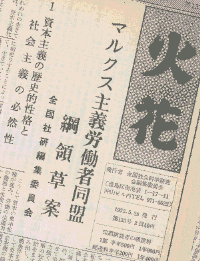 A new political organization was born !
The photograph is the 'Spark'(May the 28th,1972) on which the draft of MWL's platform was printed
But, at last, such peerless isolation had ended. After the exaltation and the setback of the Second Radicalist Movement that was carried on from the end of 1960's to the beginning of 1970's, the healthiest and the most proletarian of it had been joining Zenkokusyaken one after another.
After 1960 Anti-Anpo Struggle, radicalist movement was stagnant, but, from about 1968, it was gradually exalting through the struggles in universities and 1970 Anti-Anpo = Okinawa return Struggle.
Concerning the blowing up of the Second Radicalist Movement, we clearly pointed out the limit of it, while we were rating the revolutionary side of this movement. And we asserted that we could not and should not lead such petit-bourgeois radicalist movement.
In May, 1969, immediately after the Second Radicalist Movement, we hold the third general meeting of Zenkokusyaken, and we stressed the necessity of 'the struggle for the revolutionary party of proletariat as follows. "Our task is to lead the revolutionary struggle of proletariat, and for that purpose, we have to build a strong revolutionary party that join hands with proletariat."
After the setback of the Second Radicalist Movement, the most proletarian parts of it had begun joining Zenkokusyaken one after another, and the condition of the transformation of Zenkokusyaken to the political organization of proletariat had begun getting ripe.
This third general meeting was the starting point of it. The general meeting stipulated the postwar world structure and the character of current Japanese capitalism and the revolution of the moment in the resolution which was proportionate to platform. And it also stipulated the characters of Social Democratic Party of Japan, Japan Communist Party and the New Left, and it made our practical task clear. Our papers namely 'Spark' had been issued in blanket form from No.67, December 1969, and our organs namely 'The Study of Scientific Communism' had been printed with type from No.27, which was published on May the first, 1970. They were both sold at shops all over Japan, and become means to spread our influence. On May Day, 1971, We delivered 130,000 leaflets at 16 places around Japan, making a revolutionary appeal to the proletariat.
Finally on May the 23th, 1971, the editorial committee of Zenkokuayaken adopted the resolution that "we should hold the forth general meeting next summer to form the political organization, and we should make every possible preparations for it".
In this way, forth general meeting in Tokyo, on July the 22th and 23th, 1971, become the inaugural meeting of 'Maruroudo' namely 'Marxist Workers League'(MWL). After two days long serious discussion at the meeting, we adopted the socialist platform which was founded on Marxism, and the rules which was founded on the principle of democratic centralism. After all, the revolutional political organization = the Marxist Workers League was born. And Zenkokusyaken's eight years long theoretical-organizing activities, which had been drawing a clear distinction from SDPJ, JCP and the New Left, bear fruit at last.
It is not too much to say that MWL's platform, which was adopted at the meeting, was the only platform to realize socialist revolution, which consistently applied Marxism on the reality of present Japan, on the road of Japanese revolutionary movement.
First of all, the platform theoretically defined historical character of capitalism, inevitability of socialism and significance of it. And then, it also defined the character of Japanese revolution as "it's nothing but proletarian socialist revolution to overthrow the monopolistic capital, because the rule of the monopolistic capital had been finally established and the political democracy had been realized".
The platform also clarified "The age of imperialism and the character of the Russian revolution" and elucidated a characteristic of the world system at the present age, and the historical condition of its formation. It also summarizes the domestic and foreign communist movement, and provides for a basic strategy and the duty of MWL based on it.
"The especially important meaning of this platform is as follows . That is, we succeeded in elucidation of the characteristic of the world capitalism after the World War II, and did the materialistic and Marxist analysis on the bloc of the Soviet Union for the first time in history and clarified the contradiction of this society, did complete and revolutionary criticism on the strategy of 'United front' and 'United government' which was the strategy of the international communist movement after Lenin had died, and revived the revolutionary strategy of Marxism-Leninism"("Spark" No.200).
The platform of the proletarian party makes the recognition of advanced workers about the present world and revolutionary movement united, matches the intention of the basic duty of them, and becomes the joining axis of the fight. The significance of such Marxist platforms can't be emphasized too much.
The rule adopted at the same time stands consistently on the principle of democratic centralism which is the revolutionary organizing principle of Marxism, though it is concise. And, it contains all important organizing principles which had been confirmed in the history of the communist movement.
Also, the declaration of the general convention which was adopted at the end of it declared the revolutionary workers party was born in a loud voice, ande declared to hold a big political rally in the metropolitan area at once as a large political struggle against the Tanaka regime of Liberal Democratic Party and against the opportunists of SDP and JCP, and also declared that the MWL would run from the national constituency for the House of Councilors election two years later and would do a revolutionary calling to the workers in the whole country(the platform, the rule, and the declaration of the inaugural meeting were collected to the pamphlet) .
Thus, July, 1972 became one epoch making on the history of the revolutionary movement in Japan.
Of course, no matter how the meaning was big, only winning the revolutionary platform and the rule did not prove that we had the content truly suitable for the revolutionary party of the proletariat. However, MWL won the content at every step, by actually defending the class principle of the proletariat and fighting the revolutionary political struggle.
 the Socialist Workers Party was formed!
The character at the center of the photograph is Comrade Hayasi, the chairman of SWP. This is the passage until MWL was formed, the antecedent of SWP. The reason why we introduced this in detail is that the basic character of our party appears here very well.
Afterwards, MWL had run for Diet elections six times for more than 10 years. And, we received passionate support of advanced workers in the whole country, though we were not elected. We also had fought at the head of the workers by our best in the labor unions and in the regions to unite the labour movement and socialism. Thus, in 1984 we finally leaped to the Socialist Workers Party (SWP) and adopted the new platform and the rule. The meaning of forming SWP and the importance of the platform newly adopted are written in the accompanying documents of the platform printed on this home page.
SWP had fought at the head of the workers in the labor unions and in the regions consistently holding fast to Marxism and socialist standpoint ever since. Moreover, we had put up 10 candidates in the House of Councilors elections in 1986 and in 1989 respectively, and did the large-scale socialistic propaganda, and obtained more than 150,000 votes.
But SWP is still a small party. The reason is, in above all, that the capitalism of Japan has developed marvelously for 50 years after the war, and that Japan has risen to an eminent economic large country in the world and has enjoyed prospering. However, realizing socialism is impossible, without highly developed power of production which have developed under the capitalism. After the bubble collapsed in 1990, the capitalism of Japan which had been developing consistently after the war is facing the unprecedented economic crisis and even the possibility of a financial panic is whispered .
And, the capitalist countries in the world are also facing unprecedented difficulties like Japan, and are pressing all brunts against workers and the weaks.
Therefore, we are convinced that the age of the huge struggle of working class against capitalism will certainly come in the near future, in the capitalist countries around the world including Japan. Our heroic struggle are just for that day.
Workers in Japan! And workers all over the world! Fight Together with the SWP to realize World Socialism!
The photograph is the demonstrators of SWP which opposed the reactionary education.