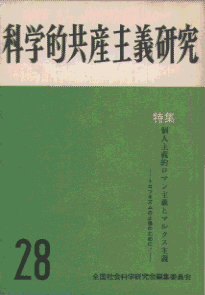
 Review of Trotsky's Chinese Revolution Policy�@
Please
send us your opinion and the impression about this article without reservation!
Contents
- Preface
- 1. The Meaning of Trotsky's criticism on the Comintern's China Policy
- 2. The Limitation of Trotsky's Chinese Revolution Theory
- The Consequence
Editing Committee of the National Social Sciences Study Association,
THE STUDY OF THE SCIENTIFIC COMMUNISM, No. 28, 1970
Part 4. Review of Trotsky's Chinese Revolution Theory (pp.33-43, written by Shiina Hiroshi)
[Preface]
I would like to review the significance as well as the limitation of
Trotsky's criticism on the Comintern which under the leadership of Stalin and
Buharin misled the Second Chinese Revolution (1925-27). Before reviewing
Trotsky's theory, first, I want to have a glance at the Comintern policy of the
Second Chinese Revolution.
In its Third Conference (June 1923) soon after the inauguration, the
Chinese Communist Party (CCP) stated under the pressure of the Comintern:
"The Chinese Kuomintong (KMT, or Guomindong) certainly is the central
force of the National Revolution," and took the strategy to order its members
to join the KMT. Before this conference, the Comintern standing committee
made a decision, declaring: "The only real national revolution group is the
KMT which includes 1) liberal-democratic bourgeoisie and peti-bourgeoisie,
2) intellectual and labors." Since "the independent proletarian movement is
still too weak and China's urgent task is to fight against the imperialism and
the domestic feudal conspirators", "it is better for the CCP to stay within the
KMT" (Comintern documents, Part II, p.19)
The Comintern considered the KMT, as an alliance of "four blocks"
of labor, peasant, intellectual and national bourgeoisie, was the only force to
promote the Chinese Revolution. I would like to review this policy later, here
I just indicate that such a "four blocks" policy, which based on the
illumination of the revolutionary character of the Chinese national
bourgeoisie, became the biggest cause for the failure of the Second Chinese
Revolution. As the consequence of this policy, the proletarian class struggle
was oppressed under the limitation of the bourgeoisie. Helped by the
Comintern, the national bourgeoisie, with their political and military
representative Jiang Jieshi, fully utilized the struggle of labors and peasants,
committed the April 1927 Shanghai coup d'etat.
This time the Comintern changed its support from the
counter-revolutionary Jiang Jieshi to the KMT "left" Wuhan government.
Stalin showed hope for it, "Wuhan's KMT will fight against the war lords and
imperialists and become the real institute of democratic dictatorship of labor
and peasants" (Stalin's Collections, Vol. 9, p.25) However, Stalin's hope was
broken in two months. The Wuhan government, fearing the development of
the labor and peasant's struggle, began to negotiate with Jiang and purge the
CCP members and labors after June 1927. Finally in September, Wang
Jingwei's Wuhan government merged with Jiang's Nanking government.
Now, the Comintern ordered the CCP to make dangerous military
uprisings. After the miserable failures of the Nanchang Uprisings, the
Autumn Harvest Uprising, the Guangzhou Uprising paid the greatest
sacrifices. Within three days several thousands were killed. Until the end of
the 1930s, too many people became the victims of the counter-revolutionary
terrorism.
"The KMT had not a statistic for the victims. By the CCP materials,
ten thousand in Shanghai, twenty thousand in Wuhan and twenty thousand in
Guangzhou were killed in 1927. Twenty thousand in Changsa of Hunan
Provence were killed between 1927 and 1928. The Chinese Red Cross
reported 450,000 people died by the terrorism between 1927-29."(Iwamura,
"A Modern History of China," Vol.2, p.10)
The "four blocks" policy and the uprisings led the failure of the
Second Chinese Revolution. Under the KMT's white terrorism, the people's
movement and CCP's organizations in urban area were stamped out. The rate
of labor in the CCP deceased from 53.8% in April 1927 to 10% in July 1928
and to below 2% in 1931 (from the note of Trotsky's Selections, Vol.4). The
CCP lost its influence within labors.
This is a general result of the leadership of the Comintern. The CCP
lost its organization by abandoning the proletarian principle. From then on,
the faction which sought bases in countryside became the CCP's center, this
caused the formulation of Maoism.
1. The Meaning of Trotsky's criticism of the Comintern's China Policy
(1) The "four blocks" policy and Trotsky
The "four blocks" policy was completely a Menshevik stance. Let us
review the difference between the Bolshevik and the Menshevik views on the
Russian revolution. Lenin requested to push a proletarian-party-led class
struggle independent from any bourgeois or peti-bourgeois movement. He
considered the revolution only can be carried out by the democratic
dictatorship of labors and peasants. On the other hand, the Menshevists
considered that since the current revolution was a bourgeois democracy, the
proletariat should only assist the liberal and obey the leadership of the
bourgeoisie.
The Menshevik strategy was to restrict the proletarian struggle within
the range of the bourgeois liberalism. Stalinists only changed "bourgeois
liberal" to "national bourgeoisie" as their "four blocks" policy to the Chinese
revolution. To justify their policy, they had to continue to show the
revolutionary character of the Chinese national bourgeoisie.
Trotsky criticized this Stalin & Buharin created absurd theory based
on the revolutionary spirit of the colonial bourgeoisie: it "translated the
Menshevism to the Chinese revolution" (Trotsky's Selections Vol.4, p.172).
Trotsky further pointed out the connection between imperialism and the
national bourgeoisie. He said that the development of class struggles of labors
and peasants would strengthen the alliance of the national bourgeoisie and the
imperialism (Trotsky's Selections, Vol.6, p.21).
On the relation of the imperialism and the national bourgeoisie, Lenin
said in the second conference of the Comintern (in July-August 1920): There
is a close relation between the imperialist bourgeoisie and the colonial
bourgeoisie. Though supporting the national movement, the colonial
bourgeoisie meanwhile always opposes revolutionary movements and
revolutionary classes with the imperialist bourgeoisie (Lenin's Works, Vol.
31, p.235). From the above teaching, we conclude that the proletariat in a
colonial country must carry out its independent class struggle from the
bourgeoisie both in theory and in organization. Further, Lenin pointed out
that even toward the bourgeois liberation movement in underdeveloped
countries with a communist color, the Comintern must keep the
independence of the proletarian movement (Lenin's Works, Vol. 31, p141).
The "four blocks" theory and what the Comintern conducted are completely
against Lenin's above thought. The Comintern ordered the CCP to enter the
KMT, losing the independence of the proletarian movement. Trotsky
severely criticized such a strategy and insisted the necessity of the
independent proletarian party. Trotsky was correct. His weak point was only
not to make the effort to realize it in practice.
(2) The Strategy of People's Uprising and the Labor-peasant Soviet
Since the proletariat must develop its independent struggle from the
bourgeoisie, the struggle would eventually develop into people's actions of
the military uprising. To develop the class struggle into military uprisings is
communists' fundamental task. Trotsky appealed to organize the independent
proletarian organization as soon as possible against the bourgeoisie, to arm
the people, to assist peasant uprisings (Trotsky's Selections Vol.6, p.73).
In China, organized labor increased from 450,000 (in 1925) to
2,800,000(in 1927), organized peasants increased from 200,000 (1925) to 3
million (1926) and 9.8 million (1927) (Iwamura, "The History of the Chinese
Revolution," p.90). What the Chinese communists should do is to organize
them to the proletarian struggle, in the form of the labor soviets and peasant
soviets (Trotsky's Selections Vol.6, p.87). However, Stalin opposed the
establishment of soviets (in Wuhan area). He was afraid of the people
uprising toward the "revolutionary KMT." He helped Jiang Jieshi to crack
down on the revolution.
Trotsky was correct. The criticism toward him by Stalinists showed
that they abandoned revolutionary principles.
2. The Limitation of Trotsky's Chinese Revolution Theory
(1) The Problems of the Alliance Policy with the KMT
However, Trotsky did not oppose allying with the KMT, he even
agreed to enter the KMT with some conditions. He considered leaving the
KMT means to leave the struggle stage of the revolution. What he wanted
was to prepare a true equal alliance with the "revolutionary" KMT.
As Lenin said, in the underdeveloped countries, sometimes it was
necessary to unite the bourgeois democrats. However, the proletariat must
keep its independence. Trotsky asked the communists to act within the
organization of the KMT. This stance was close to Stalin. Although Trotsky
emphasized the independent condition of entering the KMT, such condition
became meaningless once the communists entered the KMT. The
communists could not keep their independence within the KMT. Otherwise,
the KMT was no more a national bourgeois party. For the communists, the
first task is to promote the proletarian struggle. Only when the proletariat
insists this stance, the communists can lead the bourgeois democrats to fight
together. We must point out that Trotsky was also one of the Comintern
leaders to promote the "united front" strategy. Lenin requested the task to
gain the support of majority to clear out the ultra-left forces in the third
Comintern, however, Trotsky took this task only superficially and take the
policy to unite with the social democrats with the top importance. This was
close to Stalin's position. Trotsky was still a revolutionary, though. He could
admit the failure result.
(2) The Extension of the "Continuing Revolution Theory"
The Comintern defined the Chinese revolution as the democratic
dictatorship of labor and peasants. Trotsky considered it the reason of the
failure of the second Chinese revolution. By Trotsky, the Chinese revolution
should be directly the proletarian revolution (Trotsky Selections Vol.6,
p.109-110). The Guanzhou Uprising was the answer to the Comintern's
mistake because "the revolutionary uprising automatically led to the
proletarian dictatorship" (Trotsky's Selections Vol.6, p.111). For the Chinese
revolution, there was no road except the proletarian dictatorship. This is the
extension of Trotsky's "continuing revolution theory" to the Chinese
revolution: in an underdeveloped country, the democratic revolution can only
be completed by the proletarian dictatorship, then from there to the socialist
revolution . . .
Trotsky tried to justify his theory by the situation of China's class
relations. In China, grand & middle landlords hold close connections with
urban capitalists. There is no landlord class opposing the bourgeoisie. So the
peasant revolution meanwhile is a revolution against the bourgeoisie
(Trotsky's Selections Vol.6, p.112). However, by a rough research of the
KMT in 1926, the 333.6 million peasants were 80%of the whole population,
and 55% peasants had no land, 20% peasants had land less than 66 ares, and
6.3% peasants (landlords) had 62% land (Iwamura, "The History of the
Chinese Revolution," p.82,83). China's class relation was the pre-capitalist
relation, so the Chinese revolution must be a bourgeois revolution. In the
proletarian struggle, the land reform was an urgent issue and peasants
become another promotor of the revolution.
Since the alliance with peasants was so important, so the Chinese
revolution could not only struggle for the interest of the proletariat. The
central revolutionary task becomes the dictatorship of labors and peasants,
not the dictatorship of the proletariat. Trotsky declaimed the weakness of
Chinese peasants to justify his "proletarian dictatorship" theory (Trotsky
Selections Vol.6, p.113). However, the strength of peasants in the process of
the Chinese revolution from the Northern Expedition (1926) to the
Liberation War (1946-49) showed that Trotsky made a big mistake on this
issue.
The Chinese revolution and the later Vietnam revolution showed that
in underdeveloped countries, the revolution could not make any progress
without peasants' attendance. China's peasant population's share was more
than in Russia, Trotsky's theory was only a subjective desire without solid
ground, he could not overcome the mistake of the Comintern too.
[The Consequence]
The peasant war itself belongs to a bourgeois struggle, as Lenin told
us (Lenin's Works, Vol. 31, p.234), although in an underdeveloped country
it has the revolutionary meaning. This character will not change even though
the revolution is led by communists "with clear consciousness." The task of
the proletariat is to develop this movement further to connect with the urban
proletariat. However, Maoism justifies the peasant war as the main task of the
Chinese revolution, putting the proletarian struggle automatically as a socialist
revolution.
Return to the index of "The Critique of Trotskyism"